

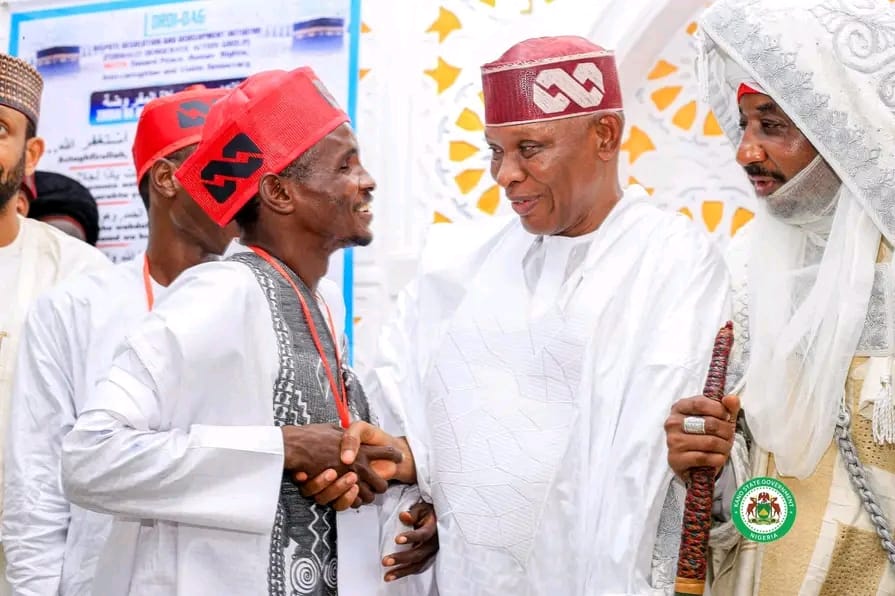
By Abdullahi Jalaluddeen
The mass wedding programme of the Kano State Government is gradually assuming a significance that extends far beyond the colourful ceremonies, exchange of vows and presentation of wedding gifts.
What began largely as a social intervention for young people seeking to establish families has evolved into a broader public policy initiative with implications for social security, economic empowerment, religious responsibility and community development.
At the heart of the programme is a recognition that marriage remains one of the most important institutions in Kano’s predominantly Muslim society. For many young people, however, the cost of getting married has become a major obstacle.
Rising prices of food, clothing, accommodation, household items and other basic necessities have made it increasingly difficult for prospective couples, particularly those from low-income households, to establish families.
By intervening in some of these costs, the government is attempting to remove economic barriers that could otherwise delay marriage.
The programme therefore represents a form of social investment. Instead of viewing marriage simply as a private affair between two individuals and their families, the intervention treats stable families as an important component of a stable society.
The argument is that when young people are supported to establish legitimate households, they are given a stronger foundation to contribute positively to their communities and the wider economy.
There is also an important social-security dimension to the initiative. Marriage, when properly established and supported, can provide a framework for mutual responsibility between spouses and the upbringing of children. Strong family structures can reduce vulnerability and provide emotional, social and economic support for members of the household.
From this perspective, the mass wedding programme can be seen as an attempt to strengthen the first layer of social protection—the family.
For the Kano State Government, the intervention also resonates with Islamic teachings concerning marriage. In a society where religion plays a central role in determining social values, facilitating lawful marriages is regarded as more than a welfare programme.
It is also an expression of public responsibility towards encouraging a social institution strongly emphasised in Islam. The government’s intervention consequently connects public policy with the religious and cultural expectations of the population.
Yet, the economic implications of the programme deserve equal attention. Every marriage creates a new household, and every new household generates demand.
Couples require accommodation, furniture, cooking utensils, clothing, food, transportation and a range of other goods and services. Consequently, supporting marriages can indirectly stimulate local markets and create opportunities for traders, artisans, manufacturers, transport operators and service providers.
The programme has the potential to generate a chain of economic activities involving Kano’s small and medium-sized enterprises. Tailors producing wedding and household clothing, furniture makers, food vendors, carpenters, metal workers, traders and other local businesses can benefit from the increased demand associated with newly established households.
If properly structured, the initiative could therefore become part of a wider local economic development strategy.
There is another important dimension: women’s economic participation. A successful marriage programme should not end when couples leave the wedding venue. The long-term value of the intervention could be significantly increased if brides and other women beneficiaries are connected to skills acquisition, entrepreneurship support, cooperative societies and access to finance.
Such complementary interventions could enable women to contribute to household income while strengthening their economic independence and resilience.
The same principle applies to the men. Many young men entering marriage face the pressure of providing accommodation, food and other necessities for their families. Linking the mass wedding programme with vocational training, employment opportunities and entrepreneurship schemes could transform the initiative from a one-time marriage intervention into a pathway towards sustainable livelihoods.
In that sense, marriage support could become an entry point into broader human-capital development.
The programme also has implications for community stability. Where economic hardship delays marriage or makes young people unable to establish independent households, frustration and social vulnerability may increase.
While marriage alone cannot solve problems such as unemployment, poverty or insecurity, policies that help young people establish responsible family lives can contribute to a more organised social environment.
This is particularly relevant in a state with a large youthful population.
However, the success of the programme should ultimately be measured beyond the number of couples married. The real test lies in what happens after the ceremonies.
Are the couples able to secure sustainable livelihoods? Can they afford accommodation and basic necessities? Are women able to access productive economic opportunities? Are the beneficiaries receiving adequate counselling on family responsibilities, financial management and conflict resolution? These questions are essential if the programme is to achieve lasting social impact.
There is therefore a strong case for developing a post-marriage support framework. Such a framework could include financial-literacy programmes, family counselling, reproductive and maternal health education, vocational training and links to existing government empowerment programmes.
It could also establish mechanisms for monitoring the welfare of beneficiaries over time. This would enable government to determine whether the intervention is producing the intended social and economic outcomes.
Another opportunity lies in strengthening partnerships with the private sector and community institutions. Financial institutions, manufacturers, agricultural cooperatives, telecommunications companies and small businesses could be encouraged to develop products and services targeted at newly married households. Rather than relying exclusively on government funding, the programme could gradually create an ecosystem in which the private sector participates in building economically productive families.
The mass wedding programme can also serve as a platform for promoting responsible family life. Marriage preparation should ideally address not only the celebration but also the responsibilities that come with establishing a home. Financial discipline, mutual respect, parenting, peaceful conflict resolution and productive engagement should form part of the broader philosophy of the intervention.
0This would ensure that government support contributes to durable families rather than merely subsidising wedding ceremonies.
Ultimately, Kano’s mass wedding programme presents an opportunity to rethink what a government social intervention can achieve. Properly implemented, it can simultaneously advance religious values, strengthen families, support vulnerable young people, stimulate local businesses and contribute to social stability.
Its greatest legacy, however, will not be measured by the number of couples who stand before the altar or exchange vows, but by the number of families that go on to build secure, productive and peaceful homes.
The wedding ceremony may last a day, but the social and economic consequences of marriage can span generations. For Kano State, the challenge now is to ensure that the investment does not end with the wedding celebration.
If the programme is connected to employment, enterprise development, skills acquisition, financial inclusion, family counselling and long-term social protection, the mass wedding initiative could evolve into one of the state’s most significant investments in human capital and community stability turning wedding bells into a foundation for stronger families and a more resilient economy.








Leave a Reply