

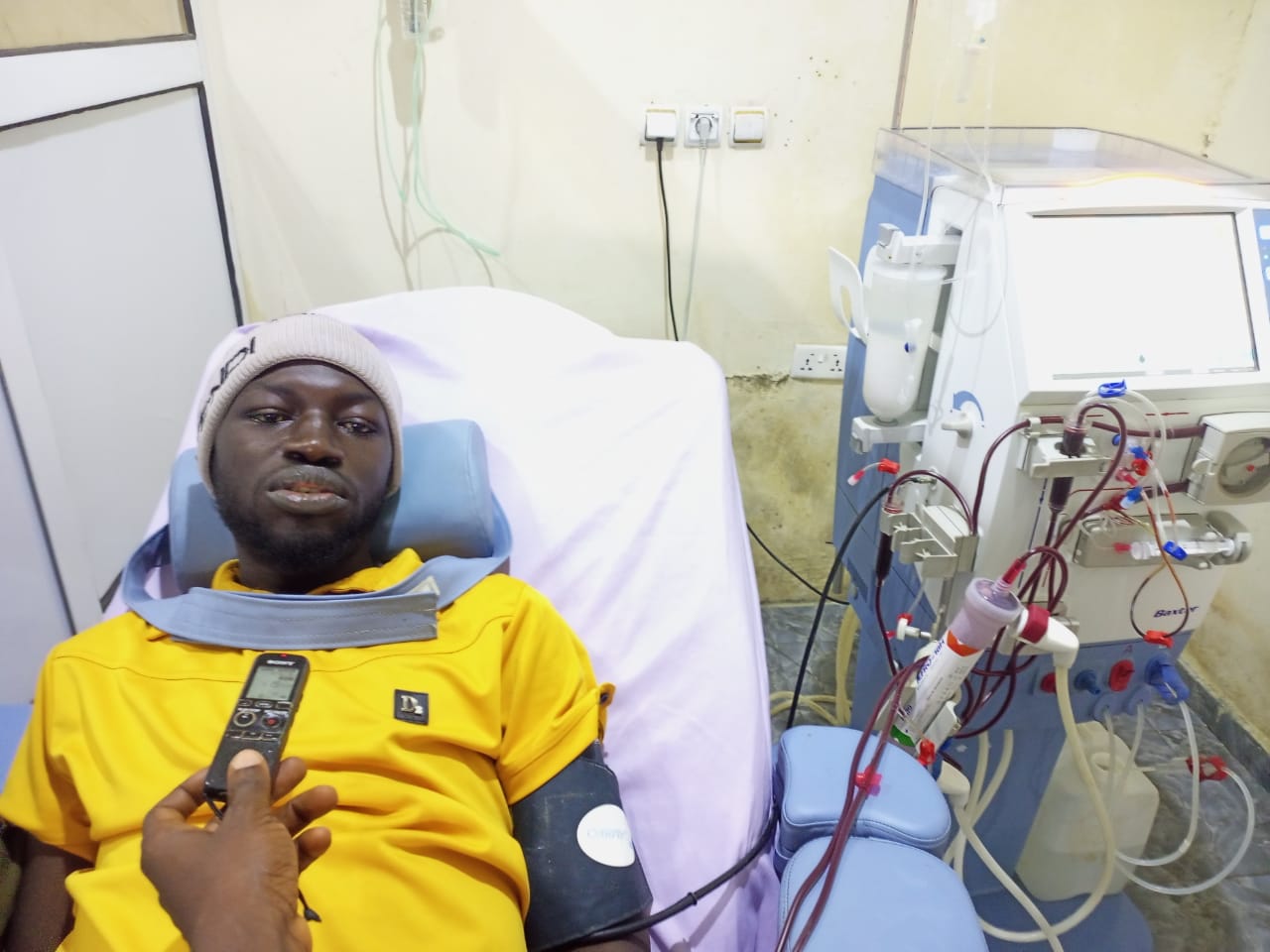
Musa Abdullahi Jingir, 30-year old Kidney failure patient undergoing Dialysis at ATBUTH, Bauchi.
By Murtala Muhammad
Financial stress is one of the factors denying Nigerians access to quality healthcare, leaving many with no option but to watch as their own or a loved one’s condition deteriorates, often with fatal consequences.
Renal failure and pregnancy-related complications are among the serious health challenges faced by many indigent citizens in Nigerian hospitals.
To reduce this financial burden, the President Bola Ahmed Tinubu administration’s Renewed Hope Agenda has introduced a subsidised dialysis programme, reducing the cost for kidney failure patients from ₦50,000 to ₦12,000 per session, among other initiatives.
Against this background, our correspondent, visited the Abubakar Tafawa Balewa University Teaching Hospital (ATBUTH) Bauchi to examine the implementation of these programmes and their impact on the citizens.
Some of the schemes being implemented include subsidised dialysis for patients with renal failure and the Comprehensive Emergency Obstetrics and Newborn Care (CEmONC), which provides free emergency caesarean sections with pre and post-operative services to vulnerable women and their newborns.
Another component is the Basic Health Care Provision Fund (BHCPF)’s National Emergency Medical Services and Ambulance Scheme (NEMSAS), which offers 48-hour emergency services for accident and gunshot victims, among other related emergencies.
During a visit to the ATBUTH Renal Centre, our correspondent met 21-year-old kidney failure patient Musa Adamu Abdullahi, who said the subsidised dialysis intervention has significantly helped him, acknowledged that in the same hospital he was previously paying ₦36,000 thousand naira for a single session.
Despite spending over a year battling kidney failure, Musa remains optimistic that he will either recover or find a benefactor to support him with the cost of a kidney transplant.
Another patient, Musa Abdullahi Jingir from Plateau State, who is in his early thirties, told Radio Nigeria that the cost per dialysis session at a hospital in Jos was far higher, stating he now prefers to spend ₦17,000 on transport to access the subsidised service in Bauchi.
Jingir said in Jos, where he left the cost per session was ₦50,000, but ATBUTH Bauchi it is being done at ₦12,000, which according to him was reasonable.
Both patients appreciated the federal government’s gesture and appealed for the complete removal of dialysis costs for kidney failure patients nationwide.
When contacted, a Consultant Nephrologist at ATBUTH Bauchi, Mohammed Rabi’u Garba, said that from January to date, the hospital’s Renal Centre has conducted one thousand and four dialysis sessions for about fifty patients.
Asma’u Ibrahim, a beneficiary of the free caesarean section service, described the federal government’s initiative as a lifesaver, noting that, given the country’s economic situation, affording a theatre fee of over ₦100,000 had been a major challenge.
A consultant obstetrician and gynaecologist at ATBUTH, Dr Dauda Batna, confirmed the hospital is implementing the federal government’s CEmONC programme, which aims to reduce maternal and neonatal morbidity and mortality.
Dr Batna noted that from January to June this year, the Obstetrics and Gynaecology Department has conducted 755 Caesarean Sections paid for by the federal government.
In an interview, the Chief Medical Director of ATBUTH Bauchi, Dr Jibril Yusuf, said the hospital’s human resources, equipment, and bed space were overstretched due to the influx of patients.
He called for urgent support from the Federal Ministry of Health and Social Welfare, as well as from philanthropists.
Radio Nigeria observed that, despite the subsidy, many patients still cannot afford the two to three recommended dialysis sessions per week.
It was also noted that the recent supply of dialysis consumables delivered by the Federal Ministry of Health and Social Welfare to ATBUTH Bauchi was for adult patients, with no equivalent provision for paediatric cases.







Leave a Reply