

By Abdullahi Jalalludeen
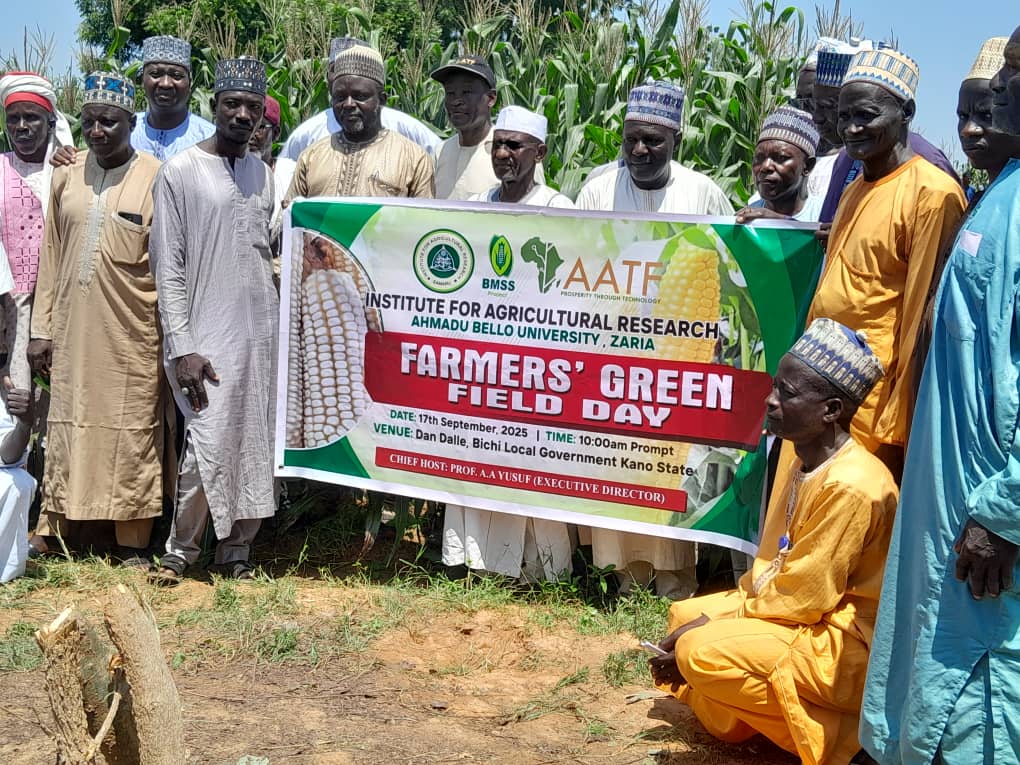
The Institute for Agricultural Research (IAR), Ahmadu Bello University Zaria, has unveiled a new generation of high-yield, drought-tolerant and pest-resistant maize varieties during a Farmers’ Green Field Day in Bichi Local Government Area of Kano State.
Speaking at the event, Professor Ado Yusuf, a senior researcher with IAR, said the field day was organized to demonstrate the benefits of the institute’s latest maize technology directly to farmers.
“Whenever we develop a new technology, we bring it to the field so farmers can see its advantages. Instead of keeping these varieties on our shelves, we extend them to farmers,”
Professor Yusuf highlighted that IAR’s mandate is to produce early generation seeds breeder and foundation seeds which private seed companies can multiply and distribute nationwide.
“There are over 200 seed companies in Nigeria. Once they collect these seeds from us and multiply them, farmers across the country should have no problem accessing certified seeds,”
Addressing concerns about genetically modified (GM) crops, Yusuf clarified that Nigeria currently has only three approved and commercialized GM crops: Bt cotton, pot-borer-resistant cowpea (SampI 20T), and Tella maize (SAMMAZ 75T).
He stressed that Nigeria’s National Biosafety Management Agency ensures all GM crops meet rigorous global safety standards.
Principal investigator Professor Rabiu Adamu said the new maize hybrids could help Nigeria overcome food insecurity.
“This maize yields 7–8 tons per hectare and matures in 90 to 95 days. It is drought-tolerant and resistant to fall armyworm and stem borer, two of the most destructive maize pests,” Adamu noted.
“Farmers using the hybrid can save up to ₦70,000 per hectare on insecticides, while protecting their health and the environment.”
Sunusi Dankawu, a Bichi farmer, praised the early-maturing, pest-resistant traits, He said “these varieties clearly outperform our local maize. We faced no real challenges except the experimental planting pattern.”
Another farmer, Bashir Usman Boyi, said community members are eager to adopt the seeds:
“People come to see and appreciate the varieties. We only need to add some micronutrients, but the yield and quality are excellent.”
The Farmers’ Green Field Day ended with a call for stronger collaboration between research institutes, seed companies, and local farmers to ensure the rapid spread of the new technology across Nigeria’s maize-growing belts.








Leave a Reply