

By Mohammed Dala Lawan
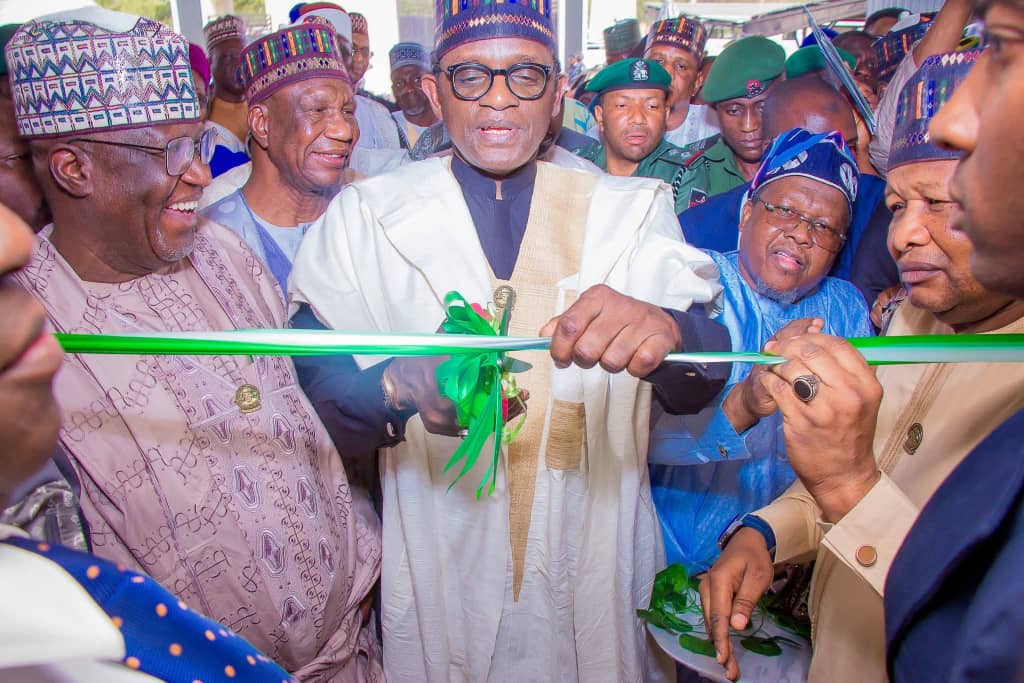
Yobe State Governor, Mai Mala Buni, has officially commissioned the permanent site of the Biomedical Research and Training Centre (BRTC) at Yobe State University, describing the facility as a landmark investment in science, education, and innovation aimed at addressing local and global health challenges.
Speaking at the event, Governor Buni said the commissioning marked “a special day in the life of his administration,”
He disclosed that his government had adopted deliberate policies to revive the education sector, enhance research, and promote innovation, including increased budgetary allocations to education.
According to him, over 800 million naira was invested in the construction of the permanent BRTC site as part of efforts to position the state in global knowledge production while addressing its peculiar needs and realities.
Buni commended the Founder and Director of the Centre, Professor Mahmoud Bukar Maina, for his “uncommon commitment and generosity,” including the donation of research equipment valued at over N10 billion, which he said provided a strong foundation for the take-off of the Centre.
The governor explained that the BRTC would enable more inclusive, accurate, and locally relevant research, stressing that Africa had for too long relied on scientific findings developed in environments that do not reflect its genetic diversity, culture, or lifestyle.
He expressed pride that the Centre had established Africa’s first major induced pluripotent stem cell biobank with an African-centred focus and was leading efforts to build one of Nigeria’s most ambitious research hubs in neuroscience and brain health, including Alzheimer’s disease research.
Governor Buni also highlighted the persistent challenge of chronic kidney disease affecting communities along the River Yobe, noting that the scourge had claimed many lives and inspired the establishment of the Centre.
He revealed that preliminary research findings were already pointing to a possible remote cause of the disease in the state.
Buni recalled leading a government delegation to the United Kingdom in 2023 to seek international partnerships for the smooth take-off of the BRTC, engagements which received encouragement from renowned scholars, including Professor Neil Pearce of the London School of Hygiene and Tropical Medicine, Professor Ben Kaplan of University College London, and Professor Jonathan Stoye of the Francis Crick Institute.
The governor further expressed appreciation to the Society of Neuroscientists of Africa for honouring him in Morocco last year and inducting him into its Hall of Fame for advancing neuroscience and addressing health challenges such as kidney disease.
He said the recognition, reportedly the first for an African governor, was dedicated to the people of Yobe State.
Reaffirming his administration’s commitment to evidence-based governance, Governor Buni pledged continued support for the state-funded Kidney Disease Research Initiative, ongoing dialysis assistance, and the establishment of an additional dialysis centre in Gashua.
He also appealed to the Federal Government to establish a Federal Kidney Disease Centre in the state.
Earlier, the Vice-Chancellor of Yobe State University, Professor Muhammad Bashir Tahir, described the commissioning of the BRTC as more than the opening of a facility, but the consolidation of an idea with growing credibility, impact, and international relevance.
He commended Governor Buni and the people of Yobe State for their foresight in investing in advanced scientific infrastructure, noting that such leadership prioritised long-term development through investment in people, knowledge, and institutions.
Professor Tahir added that the Centre exemplified how universities could host globally engaged research institutions capable of driving sustainable development, while also acknowledging the achievements of graduates of the university as strategic human-capital assets for the state and the nation.
In his remarks, the Founder and Director of the Centre, Professor Mahmoud Bukar Maina, said the commissioning represented “the opening of a possibility” for Africa to move from being a consumer of scientific knowledge to a producer.
He attributed the success of the BRTC to the supportive ecosystem deliberately created by the Yobe State Government, stressing that visionary leadership was defined by long-term institutional investments whose impact spanned generations.
The event also featured exhibitions of innovative open-science projects at the Centre, including the development of low-cost diagnostic tools aimed at strengthening community-level healthcare, particularly in rural areas.





Leave a Reply